
11 September 1942 · Hotel Atlantic, Hamburg
The birth of India’s national anthem on foreign soil
The founding of the Deutsch-Indische Gesellschaft — and the first time “Jana Gana Mana” was performed as a national anthem, on foreign soil.
The player comes from YouTube and is loaded only when you press play. Google may then process your IP address and set cookies. Privacy policy
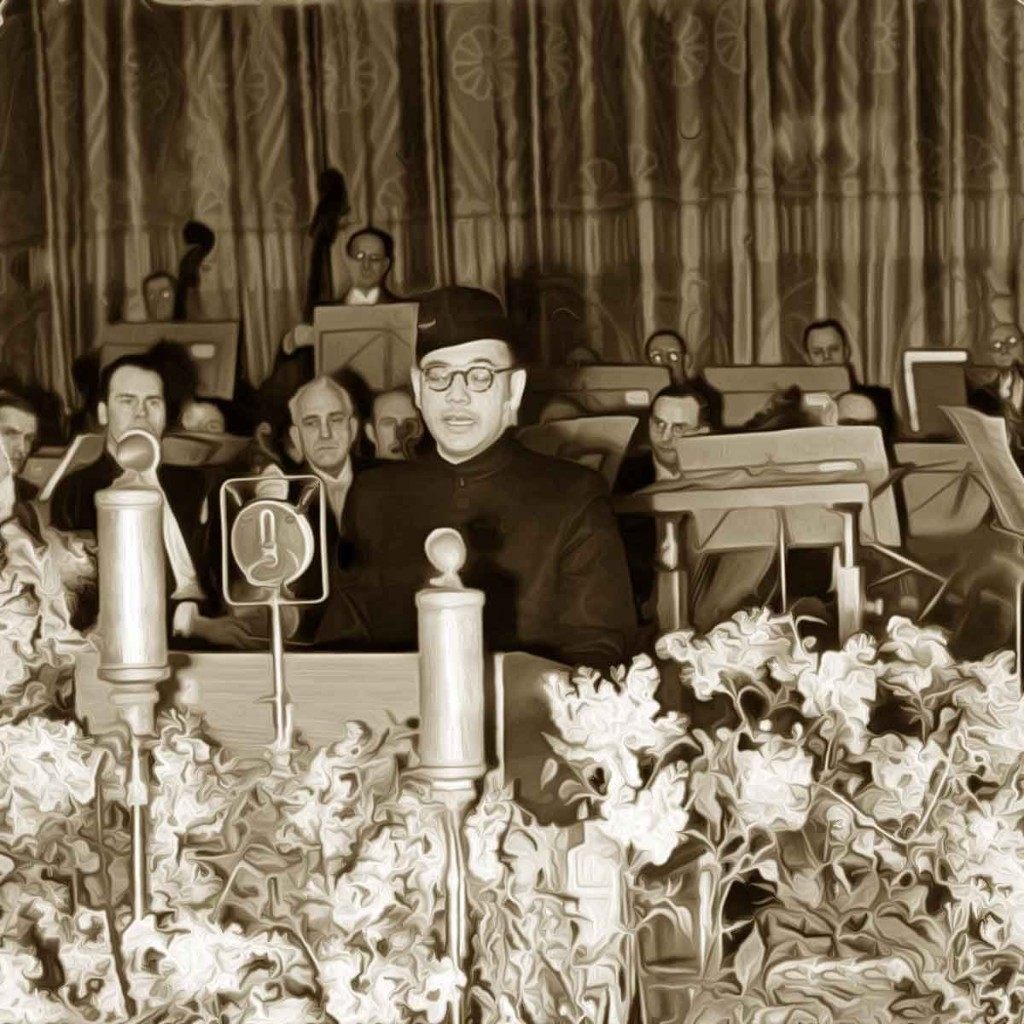
On 11 September 1942, “Jana Gana Mana” was performed publicly for the first time as a national anthem — not in India, but at the founding ceremony of the German-Indian Society (Deutsch-Indische Gesellschaft) in Hamburg’s Hotel Atlantic. That evening is the birth of India’s national anthem on foreign soil.
The anthem’s text is based on a poem and musical composition by Rabindranath Tagore, the Nobel Laureate in Literature (1913) from West Bengal. The orchestral arrangement of Tagore’s piece was created by Dr. Majumdar, an Indian composer who personally attended the premiere that evening in Hamburg. Immediately after Subhas Chandra Bose’s address, the programme called for the Indian and German national anthems.
Two anthems, one city, a century apart
Interestingly, less than two kilometres away at the Streits Hotel — also located along the Alster — another significant musical debut had taken place 101 years earlier. In 1841, the song “Deutschland, Deutschland über alles” (later known as the German national anthem) was sung for the first time by members of the Hamburg Gymnastics Club and the Hamburg Liedertafel of 1823, with lyrics by August Heinrich Hoffmann von Fallersleben.
This remarkable coincidence — two future national anthems, of India and of Germany, first performed in the same city, separated by a century — symbolises a unique parallel in the nations’ respective paths toward unity and independence.
Subhas Chandra Bose in Hamburg
A prominent participant at the 1942 founding event was Subhas Chandra Bose, leader of the Indian independence movement’s armed struggle wing. In his address, Bose expressed his firm belief that India would emerge from the Second World War as a free and independent nation. A film recording of that speech at the Hotel Atlantic is shown at the top of this page.
During the war, Bose had travelled to Germany seeking political and military collaboration in support of India’s liberation from British rule. Although these efforts did not achieve their intended outcomes, he later returned to Asia via a German submarine to continue his mission.
A national initiative
The founding ceremony, though officially registered in Hamburg, was conceived as a national initiative rather than a local one. Attendees included representatives of the German Foreign Office — among them Dr. Adam von Trott zu Solz, later executed for his role in the resistance against Hitler — as well as officials of the Free and Hanseatic City of Hamburg, and distinguished members of Germany’s academic and business communities.
While the society’s leadership — its executive committee, board, and advisory council — consisted entirely of Germans, a number of Indian representatives were also present. Under the political circumstances of the time, their participation can be seen as a symbolic gesture of solidarity with India’s struggle against colonial rule. Among them was the aforementioned Dr. Majumdar, whose music gave voice to India’s emerging national identity.
The next day’s Hamburger Fremdenblatt reported the ceremony, printed a German rendering of Tagore’s first stanza, and recorded Bose’s presence at both the Hotel Atlantic and the City Hall. The evening’s programme, those newspaper pages and a guestbook from the following day are collected at the foot of this page.
After the Second World War
The Deutsch-Indische Gesellschaft (DIG) was re-established in 1953 in Stuttgart. In the years that followed, branch societies were founded in many German cities — including Hamburg.
The Deutsch-Indische Gesellschaft Hamburg e.V. serves as a meeting place between two cultures. It provides a forum for information, dialogue, and personal exchange among people who are engaged with India and interested in its people, cultures, languages, religions, history, politics, economy and society.
Our programme includes regular meetings, excursions, lecture series, cultural events, and the celebration of Indian and German festivals. We are equally fascinated by the classical and the popular, the historical and the contemporary aspects of India — in short, by all dimensions of Indian life.
Through our concerts, cultural performances, and lectures on diverse topics, we aim to foster and deepen the relationship between Germany and India.